



The Consumer and the Cow
Success requires balancing consumer demand with a cow that can produce a quality product despite the environment in which she performs.
March 4, 2026
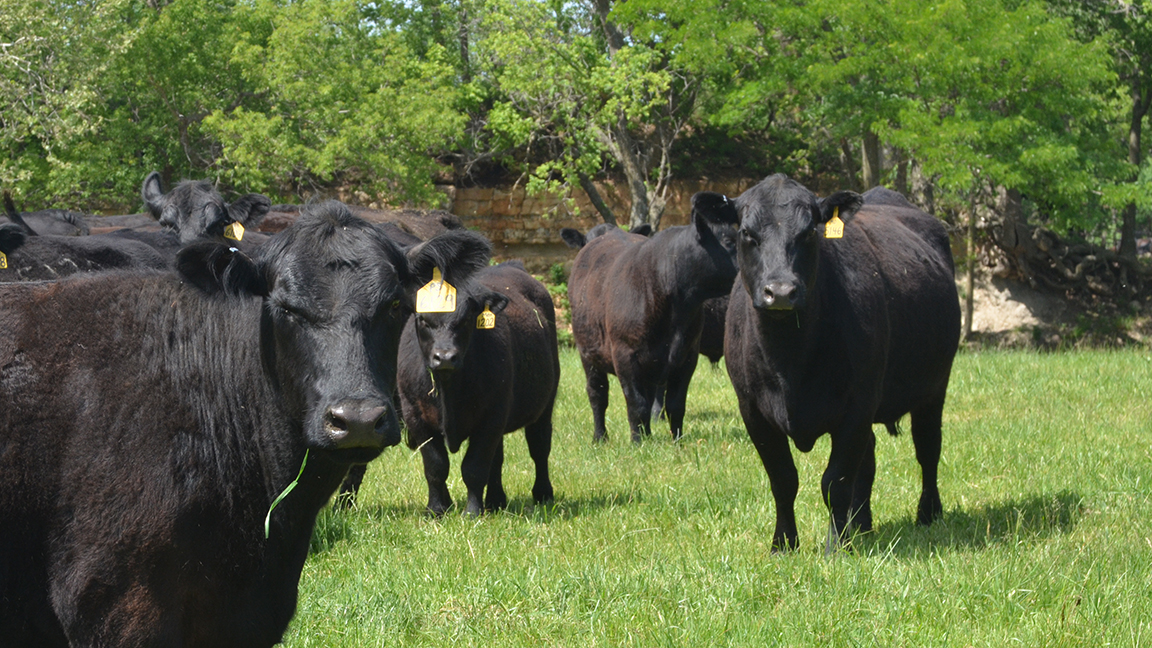

As cattle producers, we exist in an interesting spot in the timeline. The smallest herd size we’ve had in decades, strong consumer demand and a growing need to operate within the constraints set by our environment mean cattlemen are spinning a lot of metaphorical plates.
As part of a jam-packed day of events at the 2024 Cattlemen’s Congress in Oklahoma City, Okla., Angus University hosted a panel focused on balancing the consumer and the cow. Ron Hays, with the Radio Oklahoma Network, sat down with panelists Jesse Luckie and Mark Johnson to discuss how cattle producers can balance consumer demand with a cow who can produce a quality product despite her environment.
The perfect combo
When you think about balancing maternal traits with those traits that affect a consumer eating experience, what might you have in mind? For Luckie, a commercial cattleman operating in Kansas and Oklahoma, the answer comes quickly.
“Number one, I think we need to keep the consumer in mind. That’s our end product. That’s our report card for what we do day in and day out,” Luckie says, adding that none of that matters without a live calf. “We have to have a live calf. So, we need to concentrate on these traits that are highly heritable but also create a cow that’s suitable to the environment that we operate within.”
Luckie explains that in order to find the right combination of traits, producers have to approach everything from a holistic point of view.
“I think a combination of genetic selection, good management and understanding trends really serves as the catalyst to meeting the consumer’s demands,” he adds.
Echoing Luckie’s comments, Johnson encourages listeners to think about incremental consumers.
To define who incremental consumers are from his point of view, Johnson provides a few examples.
“As purebred seedstock producers … we may sell this bull to a commercial cow-calf [operator] who sells their calves at weaning,” Johnson says. “That is our consumer, but whoever is buying those weaned calves is their consumer.”
Other examples of incremental consumers include someone who sells their calves as yearlings off wheat or a producer who sells show prospects to junior 4-H and FFA exhibitors.
“I think a combination of genetic selection, good management and understanding trends really serves as the catalyst to meeting the consumer’s demands.” — Jesse Luckie
As part of such a diverse industry, there are varying consumer demands that must be met; but one point rings especially true for Johnson: “We can never lose sight of the importance of that efficient cow that raises a calf to weaning every year for us.”
The ideal female
Getting our consumers what they desire — regardless of whether that product is a live animal or packaged beef at the grocery store — doesn’t happen without efficient bred cows.
While a bred female is where it begins, Luckie says the end product is where his operation is fine-tuning things.
“Every operation’s different, and Texas is not Kansas. Nebraska is not Montana. I don’t think there’s a right answer. I think you have to judge that and judge your own operations uniquely,” he explains. “Even though we’re all in the same business, our operations are uniquely different enough to change the whole dynamic. I don’t think you can paint everything with one brush.”
Is there a cow size that’s too big in his opinion? Absolutely. While we’ve probably seen that size play a role in our industry, Luckie doesn’t feel cow size is the single most deciding factor of how we should choose our genetic pool.
“Time and time again, I think quality pays. Even within the Angus industry, there’s two segments of thought: the terminal breeders versus the maternal breeders. I don’t think those are mutually exclusive,” Luckie states, adding that it takes one to have the other. “It’s that holistic balance that we look at to get that live calf on the ground and then to perform at the feedyard and hang on the rail in that high-Choice or Prime category. To say we have to choose between one or the other, I don’t think those two qualities are mutually exclusive.”
Johnson sums the session up with a bow when noting that data available through the National Beef Quality Audit is proving cattlemen are producing a more consistent and enjoyable eating experience for the average beef consumer at the grocery store.
“We’ve got a higher-quality product. Virtually all fed cattle are reaching Choice and higher quality grades. Within those quality-based branded [beef] programs, we’re seeing higher certification rates,” he says. “It is a success story that our industry can tell where genetic change and better management have led to a better product that consumers … are willing to pay a premium for.”
Editor’s note: The information above is summarized from the Jan. 31, 2024, episode of Angus at Work. To access the full episode — including more on the relationship between consumers and beef producers — check out our Angus at Work archive on www.angus.org. [Lead photo by Kasey Brown.]
Angus Beef Bulletin EXTRA, Vol. 18, No. 3-A
“It is a success story that our industry can tell where genetic change and better management have led to a better product that consumers … are willing to pay a premium for.” — Mark Johnson
Topics: Consumer , Female Foundations , Management
Publication: Angus Beef Bulletin
Related Content