




ANGUS ADVISOR
Angus Advisor: Southern Region
Our team of Angus advisors offer regional tips for herd management.
April 28, 2026
What makes a good embryo recipient?
As the genetic merit of embryos increase, small management decisions carry greater consequences. Among those decisions, recipient selection remains one of the most influential factors affecting pregnancy outcomes in embryo transfer (ET) programs.
A successful ET program begins well before transfer day. For example, days postpartum is an important driver of fertility. Recipient cows must have adequate time after calving to resume cyclicity before entering an estrous synchronization protocol. Cows too early in their postpartum period often respond inconsistently to synchronization, and are less likely to become pregnant.
In most operations, recipients that are at least 45 days postpartum at the start of the protocol, depending on nutritional status and overall management, represent more dependable candidates.
Response to the estrous synchronization protocol is another critical factor. Expression of behavioral estrus following the protocol reflects appropriate follicular development, endocrine function and uterine readiness. Cows that express estrus consistently achieve higher pregnancy rates than cows that do not exhibit estrus. Cows that express estrus are less likely to experience pregnancy loss after the establishment of pregnancy.
However, cows failing to express estrus can and do become pregnant, particularly in well-managed fixed-time ET programs. Lack of visible estrus should not automatically exclude a recipient from receiving an embryo. Instead, estrous expression should be viewed as a positive indicator that helps prioritize more fertile recipients among candidates.
BCS remains one of the most practical management tools available. Recipients should calve in adequate condition and maintain a BCS of 5 to 6 on a 1-to-9-point scale. Cows in a negative energy balance prioritize maintenance and lactation over reproduction.
Research from our group shows when embryo recipients on a negative energy balance respond well to the synchronization protocol, they are less likely to maintain pregnancy after ET compared to cows with an adequate energy balance (Figure 1).
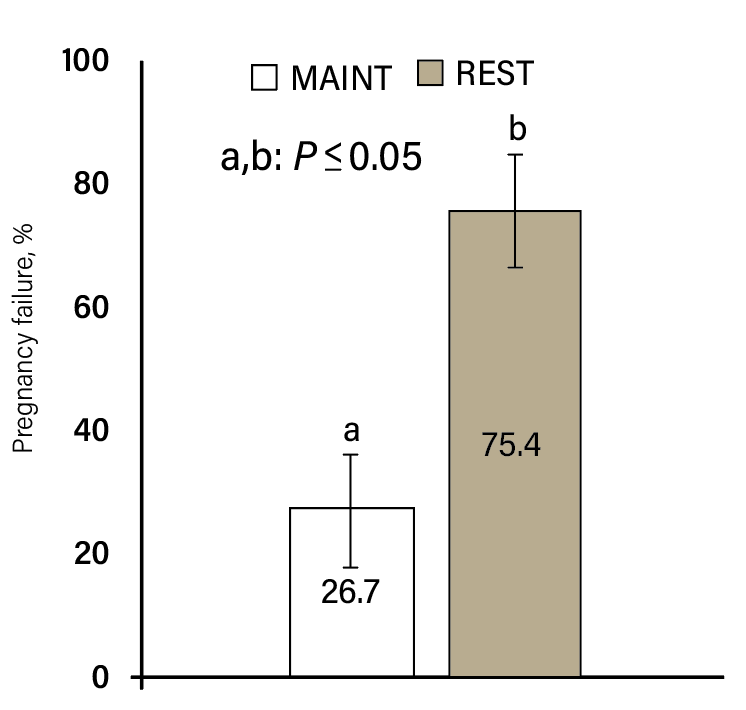
FIG. 1: Recipients fed an energy restriction diet (REST; 70% of energy requirements) experienced a greater (P ≤ 0.05) percentage of pregnancy failure compared with recipients that received a diet designed to meet their energy requirements (MAINT).

History is paramount. Cows with a 365-day calving interval that breed back promptly, calve unassisted and maintain structural soundness are proven females. Even more valuable are cows that have previously carried an ET pregnancy to term. These females have already demonstrated uterine competence under ET conditions. In many herds, track record is more predictive of success than any technology applied on transfer day.
Evaluation of the corpus luteum (CL) is the final checkpoint before transfer. A functional CL is essential because it produces progesterone, the hormone that supports early pregnancy establishment. Traditionally, practitioners assess CL presence and size through palpation or conventional ultrasonography. While size provides useful information, it does not always reflect functional capacity.
Emerging tools such as color Doppler ultrasonography offer additional insight into CL function. Unlike conventional ultrasound imaging, color Doppler evaluates blood perfusion within the CL. Greater blood perfusion is generally associated with greater luteal activity and progesterone production (Figure 2). Research evaluating luteal blood perfusion in embryo recipients has demonstrated cows with greater CL blood perfusion at the time of transfer achieved greater pregnancy rates than cows with minimal perfusion, even when CL size was similar (Figure 3).
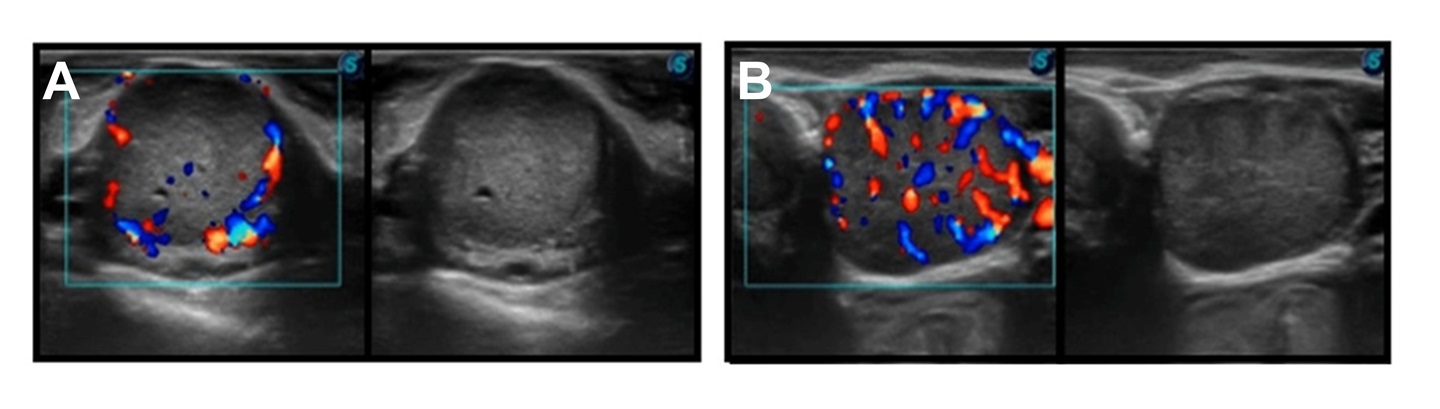
FIG. 2: Representative color Doppler ultrasonography images of the corpus luteum (CL) at the time of embryo transfer. Panel A illustrates a CL with low blood perfusion, whereas Panel B demonstrates a CL with high blood perfusion. Color signals indicate vascular blood flow within the CL.

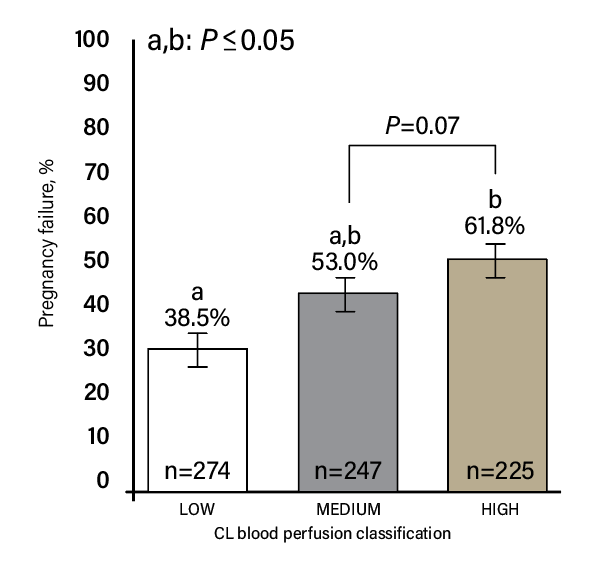
FIG. 3: Pregnancy rates of embryo recipients classified according to CL blood perfusion at the time of transfer. Recipients with high CL blood perfusion achieved greater pregnancy rates compared with recipients classified as low perfusion (P ≤ 0.05), with intermediate responses observed in the medium group.

These results indicate luteal blood perfusion information can be used to (1) avoid recipients less likely to become pregnant after transfer or (2) to prioritize specific recipients when transferring high-value embryos.
In summary, success in ET rarely hinges on a single dramatic intervention or the latest technology. It is the result of disciplined management and attention to detail. Adequate days postpartum, a strong estrous response, optimal body condition, proven reproductive history, and a functional CL form the foundation of recipient fertility. Emerging tools can refine those decisions, but they cannot replace the fundamentals. In ET programs, consistent results come from stacking small advantages rather than searching for shortcuts.

by Pedro Fontes
University of Georgia
pedrofontes@uga.edu

Topics: Animal Handling , Business , EPDs , Equipment / Facilities , Feedstuffs , Foot score , Genetics , Health , Management , Nutrition , Pasture and Forage , Record Keeping , Reproduction , Sire Evaluation
Publication: Angus Journal
Related Publication Articles



Current Angus Journal
Keep up on the latest stories of the people and programs in the breed.

Latest Podcast Episode
Don’t miss conversations with breeders and industry experts.