

Data Driven Herd
The Data Driven Herd program recognizes members committed to the collection and submission of data on multiple traits to AHIR® to help better characterize phenotypes in both their herd and the Angus breed.

WHAT IS A DATA DRIVEN HERD
Launched in August 2025, the program recognizes herds who contribute a set of phenotypes on multiple traits of their choosing each year. Earning this recognition communicates to your customers and the industry your commitment to characterizing your herd through the collection of phenotypic data.
Herds are recognized annually at Angus Convention, have use of the level logo for advertising and are listed on Angus.org.
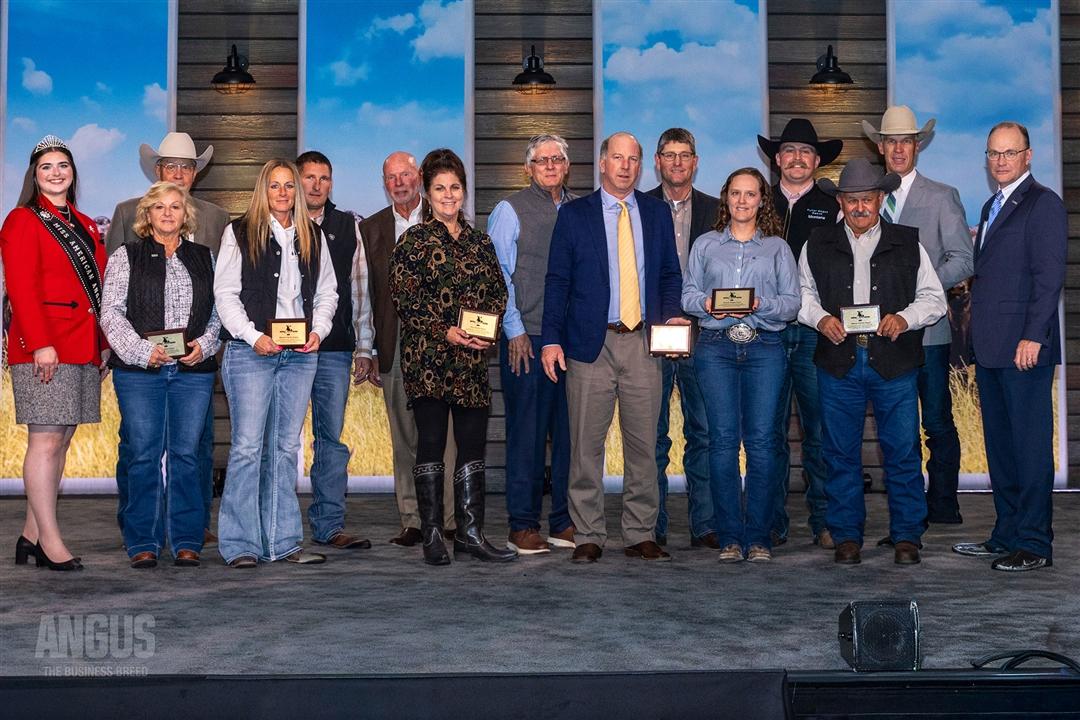
Members who earned Gold Level in 2025 were recognized on stage during Angus Convention.

Better Together
“If someone knows what they’re buying with a higher degree of accuracy, having a favorable outcome in their program is a lot more likely. That’s the way I see the role of our EPDs and our data systems. It gives us an advantage to predict outcomes for our customers."
Lee Duckworth
Grassy Valley Angus | Greeneville, Tenn.
Data Driven Herd | 2025 Gold Recipient
HOW TO EARN DATA DRIVEN HERD RECOGNITION?
Herds can earn Gold, Silver or Bronze recognition each year by completing the following requirements, which are tailored to each individual herd based on herd size.
The annual reporting period runs August 1 to July 31.
Enroll in AHIR’s Inventory Reporting Program
Enrolling in the Inventory Reporting program allows AHIR to establish the number of females in your herd and then determine the minimum required phenotypes for each trait.
There are two Inventory Reporting enrollment periods each year; November – January 15, for primarily spring-calving herds and May – July 15, for primarily fall-calving herds. Herds that calve in multiple seasons should determine the period that best fits their operation.
Learn more about Inventory Reporting
 Earn Bronze Level
To earn Bronze, herds must submit at least 8 traits. Each trait has a minimum number of phenotypes required. The minimum requirement for your individual herd is based on the number of cows enrolled in Inventory Reporting.
 Earn Silver Level
To earn the Silver level recognition, herds must report at least 10 traits, meeting the minimum number required for your individual herd.
Earn Gold Level
To earn the top recognition level, Gold, herds must submit at least 12 traits, meeting the minimum number of required phenotypes for each trait and also earn Inventory Reporting’s MaternalPlus® distinction.
Track your progress
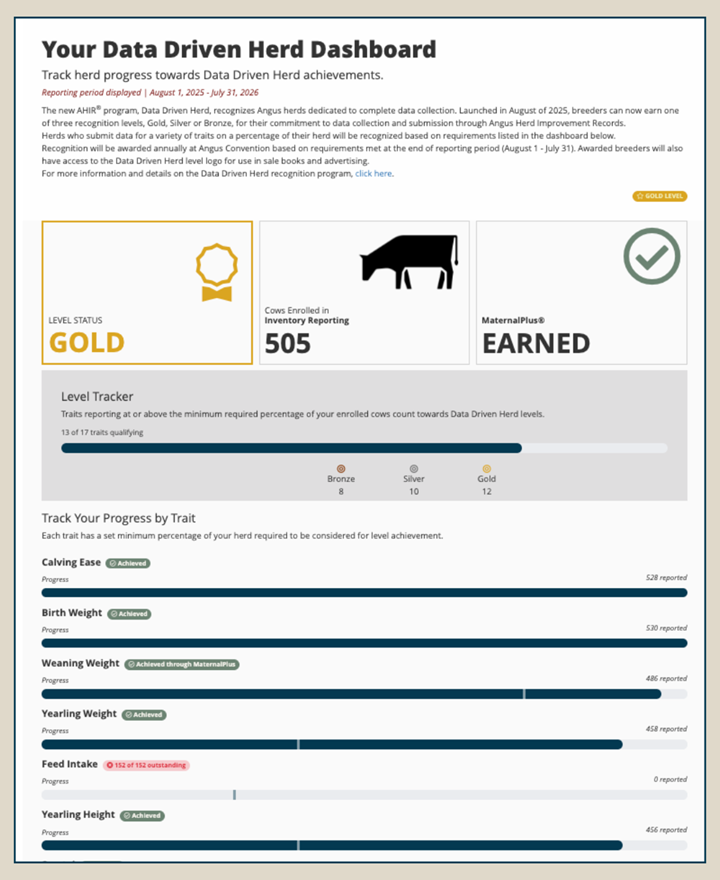
Are you a Data Driven Herd? Members can track their progress towards recognition through the dashboard in AAA Login. You’ll be able to see the customized requirements built off of your cow inventory and the number of phenotypes submitted for each trait.
DETERMINING THE PERCENT REQUIRED
Each trait’s required percentage was defined to be a realistic goal based on the trait and the number of records a herd may be able to collect.
For example, scrotal requires a minimum of 20%. For a herd with 100 cows enrolled, at least 20 yearling scrotal measures are required. Twenty percent is required for scrotal as we consider that approximately 50% of the calf crop will be bulls, and not all those bulls will remain in the herd until yearling age.
For phenotypes to meet requirements for each trait, they must be collected within the appropriate age window for the individual trait.
Note: Herds who have earned MaternalPlus® distinction for the year will automatically meet the Data Driven Herd requirements for weaning weight and breeding records.


Creating Contemporary Groups | WEBINAR
Contemporary Groups
While the minimum number of phenotypes were set for meeting the requirements of the program, submitting complete contemporary groups is still the best practice for genetic comparisons. The practices ensures that calves receive appropriate credit for their performance within the herd.
Submit Data - Leveraging AAA Login | ANGUS UNIVERSITY
Resources for Data Submission
Once you’ve collected a set of data, it can be submitted to the Association through AAA Login, Association Excel spreadsheets, AIMS or other herd management software, or paper forms.
DATA DRIVEN HERD FAQ'S
The number of records required is specific for each individual trait. The minimum number of records required is a percentage of an individual herd’s females enrolled in Inventory Reporting. The percentages were set to be attainable to achieve, but also realistic for each specific trait and the number of records a herd may be able to collect.
This program focuses on phenotypes submitted through Angus Herd Improvement Records (AHIR®).
Data submitted by the enrolled herd will count towards the total. The number of dams enrolled in Inventory Reporting is used to establish the minimum number of records for each trait.
For example, if an ET calf is born to a commercial recipient that is not enrolled in Inventory Reporting, the records from that calf will still be counted. Another example, recently purchased females who may not be enrolled in Inventory Reporting for your herd yet, may still produce individual phenotypes or phenotypes from her calf that can be reported.
Herds who have earned a Data Driven Herd level will be notified of their recognition status after the close of the annual reporting period (August 1). Notification will include instructions on how to get the award year level logo and guidelines for use in herd marketing.
AHIR’s Data Driven Herd recognition program runs August 1 – July 31. The reporting period was updated in February 2026 to better align with the natural workflow of both spring and fall calving herds. For example, data submitted between August 1, 2026 – July 31, 2027 will count towards 2027 Gold, Silver and Bronze levels.
Inventory Reporting is used to establish an individual herd’s base for the minimum number of required phenotypes for each trait. Enrollment for Inventory Reporting can be done through AAA Login during one of two enrollment periods:
Spring Calving Herds: Nov. 1 – Jan. 15
Fall Calving Herds: May 1 – July 15
If a herd calves in spring and fall, choose the enrollment period that best suits the majority of the herd.
At the time of enrollment, members will need to clean up their herd inventory by marking females active or inactive using the wizard on the homepage of AAA Login.
Data reported does not have to be in a proper contemporary group to count towards a herd’s minimum number of records for a trait. For example, traits submitted for animals in a single animal contemporary group are counted. However, complete contemporary groups are the best way to ensure that individuals receive credit for their performance within the herd.
Members are encouraged to ensure data is grouped properly.
Only the main herd enrolled in Inventory Reporting will be recognized for the Data Driven program. Herds linked under the main account contribute to the main herd but will not be recognized individually.
MaternalPlus® is a level within Inventory Reporting, which is AHIR’s whole herd reporting program. It requires weaning weights and heifer breeding records to be submitted. MaternalPlus recognizes herds dedicated to reporting whole herd data focused on improving selection for maternal traits.
Data Driven Herd recognizes herds that are submitting a variety of phenotypes for their herd. These may include the traits required for MaternalPlus, but will also require additional traits outside of MaternalPlus requirements.

Learn more about MaternalPlus®
The MaternalPlus® logo shows your operation is dedicated to complete data reporting, which provides you and your customers with information to make effective selection decisions and expands reproductive and cow longevity tools.